Logistics Specialist (FPE) (Thun):
1 Provider - 1 Training locations


Training providers in your region
Baarerstrasse 137
6302 Zug


Schools with certified educational counseling

Sites in the region Berne and Thun:
Education location / Schools Thun
Questions and answers
What is the difference between a logistics specialist and a logistics professional with a Federal VET Diploma?
The main difference lies in the level of education and the professional responsibilities. The Logistics Specialist with a Federal VET Diploma is part of advanced vocational education and training (VET), while the Logistics Specialist with a Federal Certificate is part of advanced vocational education and training (VET). The certificate builds on professional experience and qualifies you for more advanced roles in logistics.
The two degrees differ, in particular, in the following ways:
- Logistics Specialist (Federal VET Diploma): You will complete a vocational education and training (VET) program and acquire the practical and theoretical foundations for working in warehousing, distribution, or other areas of logistics.
- Logistics Specialist: You will deepen your knowledge and develop skills in the planning, management, and optimization of logistics processes.
- Educational Path: The Federal VET Diploma is typically earned through a vocational apprenticeship. The Federal Vocational Certificate requires relevant professional experience and fulfillment of the examination eligibility requirements.
- Professional Responsibility: With this professional certification, you can prepare yourself for more challenging technical, coordination, and leadership roles.
The two degrees are therefore not equivalent or interchangeable; rather, they belong to different levels of vocational training. If you already hold a Federal VET Diploma as a logistics specialist and have gained professional experience, continuing education to become a logistics expert could be a possible next step in your career.
Is the "Logistics Specialist" certification recognized by the Swiss government?
Yes, the Logistics Specialist certification is a federally recognized qualification in advanced vocational education. After passing the federal professional examination, you will receive the protected title “Logistics Specialist with a Federal Certificate” or “Female Logistics Specialist with a Federal Certificate.”
Federally Certified Logistics Specialist—here’s what that means in practice:
- The Federal Professional Examination is based on a set of examination regulations approved by the federal government.
- The exam assesses your professional competencies in various areas of logistics.
- Once you have passed the exam, you will receive the Swiss Federal Certificate.
- This degree is part of advanced vocational education and is based on professional experience and the relevant admission requirements.
The professional certificate is therefore more than just an internal school certificate. It confirms your qualifications at the federal level and can open up new career opportunities for you in logistics.
More aboutAwareness and image
Can I become a logistics specialist even if I'm changing careers?
Yes, even without formal training as a logistics specialist, you may be admitted to the Federal Professional Examination under certain conditions. The key factors are your prior education and your documented professional experience in a logistics field. However, a traditional career change without relevant experience is not automatically possible.
According to the admission requirements, the following options are particularly suitable:
- With a Federal VET Diploma, Maturität, or equivalent degree: at least three years of professional experience in procurement, production, warehousing, distribution, or waste management.
- With a Federal VET Certificate (EBA): at least five years of professional experience in one of the listed logistics fields.
- If you do not have one of these degrees: at least eight years of professional experience in one of the logistics fields listed.
- With another Swiss professional certificate: A degree in one of the listed logistics fields may also qualify you for admission.
In addition, you must provide proof of the required SSC basic module certifications or equivalent certifications. Before registering with the relevant examination organization, you should clarify whether your previous education and work experience will be recognized. This will help you determine whether you will be admitted directly to the Federal Professional Examination or if you still need to meet certain requirements.
Find out more about other degrees in ourAdvisor
How much does a logistics specialist earn?
Your salary as a logistics specialist depends on your professional experience, the industry, the region, and your specific role. The scope of your responsibilities also plays an important role. As a rough guide, GS1 Bildung cites a monthly salary range of approximately CHF 5,500 to CHF 7,500 and a median of about CHF 6,500.
Your actual earnings as a logistics specialist are influenced in particular by the following factors:
- Work Experience: Several years of experience in logistics can have a positive impact on your salary.
- Function: Subject-matter expertise, project management, or leadership responsibilities can influence salary levels.
- Sectors and Companies: Manufacturing, retail, transportation, and logistics services have different wage structures.
- Region: The place of work and regional wage levels also play a role.
The figures listed are guidelines and not guaranteed salaries. For a personalized assessment, you should consider comparable roles and your previous work experience. With the Federal Certificate of Competence, you can expand your qualifications to take on more challenging tasks in logistics.
Read more about theWages
What are the duties of a logistics specialist?
Logistics specialists ensure that goods, information, and resources flow as efficiently as possible through a company and its supply chains. They analyze existing processes, coordinate various stakeholders, and develop solutions to improve costs, time efficiency, and quality. The most important tasks of logistics specialists include:
- Analyzing and optimizing logistics processes: Examining existing workflows, identifying opportunities for improvement, and developing measures to ensure that goods and information flow more efficiently.
- Coordinating the flow of goods and information: Ensuring that materials, products, and the associated information are available at the right place and at the right time.
- Manage logistics processes: Plan, coordinate, and monitor tasks related to procurement, production, warehousing, distribution, and disposal.
- Identify weaknesses and implement improvements: Identify sources of errors, delays, or unnecessary costs, and propose appropriate optimization measures.
- Planning Logistical Subprocesses: Organizing individual procedures and work steps, allocating resources, and monitoring implementation.
- Help develop logistics concepts: Contribute to the planning and further development of warehousing, transportation, procurement, and distribution solutions.
- Support or lead projects and teams: Participate in logistics projects, coordinate tasks, and, depending on the role, supervise employees or teams.
- Coordinate interfaces: Ensure collaboration among departments, suppliers, freight forwarders, customers, and other stakeholders.
- Evaluating Key Metrics and Processes: Analyze data on costs, delivery times, inventory levels, and process quality, and use these insights to identify opportunities for improvement.
- Consider safety and sustainability: Ensure compliance with occupational safety regulations and make sure that goods are stored, transported, and disposed of properly and in the most environmentally friendly manner possible.
The duties of logistics specialists thus combine organizational, analytical, and coordinating tasks. Depending on the company and area of work, the focus may be on procurement, warehouse logistics, production, transportation, or distribution, for example.
What is the structure of the Federal Professional Examination for Logistics Specialist (with a federal certificate), and what topics are covered on the exam?
The Swiss Federal Professional Examination for Logistics Specialists consists of five parts and includes both written and oral exams.
Among other things, the assessment covers competencies in the following areas:
- Process Management, Procurement Logistics, Materials Management, and Production Logistics
- Standards and Systems, Warehouse Logistics, and Distribution Logistics
- Waste Management Logistics and Occupational Safety
- The Overall Logistics Process and Other Technical Issues
- Subproject and Team Leadership
The specific exam formats and weightings are based on the current examination regulations and guidelines issued by GS1 Switzerland. The Federal Professional Examination for logistics specialists assesses not only theoretical knowledge but also the skills required to handle typical professional situations.
Conclusion:Anyone wishing to earn the Swiss Federal Certificate should tailor the course specifically to the current exam requirements.
What advanced training programs can be completed after passing the Federal Professional Examination to become a logistics specialist with a federal certificate?
After earning the Federal Certificate as a Logistics Specialist, various continuing education programs in logistics, supply chain management, leadership, and business processes are available. Which program is appropriate depends on your career goals and the respective admission requirements.
Possible directions include:
- Advanced Federal Professional Examination (AFPE) in logistics or supply chain management
- Continuing Education in Supply Chain Management
- Continuing Education in Process and Project Management
- Leadership Development Programs
- Colleges of Higher Education, provided that the admission requirements are met
- CAS, DAS, or MAS at Universities
At GS1, the former continuing education program for logistics managers has now been integrated into the newly designed program for supply chain managers, specializing in corporate logistics.
The professional certificate can serve as a foundation for further specializations and higher qualifications, but it is not automatically linked to a specific advanced training program.
What are the eligibility requirements for the Federal Professional Examination for logistics specialists?
Depending on your prior education, different lengths of practical experience are required for admission to the Federal Professional Examination to become a logistics specialist. In addition, you must have completed the required SSC basic modules or provide proof of equivalent qualifications.
Eligibility for the Federal Professional Examination to become a logistics specialist, depending on prior education:
- Federal VET Diploma, Maturität, or equivalent degree: at least 3 years of relevant professional experience in logistics
- Federal VET Certificate or equivalent degree: at least 4 years of relevant professional experience
- Without a relevant degree: at least 8 years of relevant professional experience
- Corresponding Swiss professional certificate: admission may also be granted in accordance with the examination regulations
- In addition: required SSC basic module certifications or confirmation of equivalency
Professional experience must have been gained in the relevant logistics areas, such as procurement, production, warehousing, distribution, or recycling/disposal. The relevant examination board decides on final admission.
Conclusion:Eligibility for the Logistics Specialist training program should be verified before the start of the course based on the current examination regulations.
What skills does the Logistics Specialist program with a Federal Certificate teach?
The continuing education program for logistics specialists provides technical, methodological, and leadership skills for more challenging tasks in various areas of logistics.
These include in particular
- Analyze and Optimize Logistics Processes
- Understanding Procurement, Production, Warehousing, and Distribution Processes
- Coordinating the Flow of Goods and Information
- Evaluating Logistics Systems and Key Performance Indicators
- Plan Processes in a Cost-Effective and Structured Manner
- Support projects and improvement initiatives
- Coordinate employees or teams
- work with internal and external interfaces
- Analyze problems and develop proposed solutions
Above all, this degree enhances the ability not only to carry out logistical processes, but also to evaluate, coordinate, and further develop them.
How long does the Logistics Specialist further training program last?
The duration of the Logistics Specialist further training program varies depending on the educational provider and the instructional model. At GS1 Bildung, for example, the program lasts three semesters, or about 18 months. Other providers also offer part-time programs with different time frames.
The actual duration depends, among other things, on the following factors:
- Number of class sessions and their distribution across semesters
- Part-time or other instructional models
- Scope of Self-Study and Exam Preparation
- Prior knowledge and any recognized prior coursework
- Date of the Federal Professional Examination
If you want to complete the Logistics Specialist continuing education program while working, you should consider not only the duration of the course but also the weekly time commitment. Therefore, compare the schedules and teaching methods of the various training providers before making your decision.
Find with theSelf-testFind out if this training program is the right fit for you.
How much does the continuing education program for logistics specialists cost?
The cost of the Logistics Specialist continuing education program varies depending on the educational provider, the teaching model, and the services included. At GS1 Bildung, for example, tuition currently amounts to approximately CHF 13,000, including exam fees. Costs may vary among other providers.
When planning your budget, you should pay particular attention to the following points:
- Course fees: Course fees vary depending on the provider and duration.
- Exam fees: Check whether the Federal Professional Examination is already included in the price.
- Additional expenses: Costs for teaching materials, travel, or lodging may apply.
- Federal Grants: For eligible preparatory courses for the Federal Professional Examination, you can claim a refund of 50 percent of the course fees under certain conditions, up to a maximum of CHF 9,500.
It is important that the preparatory course you attend is listed on the federal government’s registry for the year you begin the course and that you meet the other requirements. Applications for federal grants are generally submitted after you have passed the federal examinations. Therefore, plan on having to cover the course costs yourself initially. Compare the programs for the Logistics Specialist continuing education, further training track and check which costs are actually eligible for reimbursement before registering.
Read more here about possibleDisadvantages of the Training Program
Who is the Federal Professional Examination for Logistics Specialist with a Federal Certificate suitable for?
The continuing education program for logistics specialists is particularly well-suited for professionals who already have practical experience in logistics and wish to deepen their technical and methodological skills.
It may be of particular interest to people from:
- Inventory and Materials Management
- Procurement and purchasing
- Production logistics
- Distribution and transportation
- Freight Forwarding and Logistics Services
- Supply Chain Management
- Operational logistics and project functions
To be eligible for the Federal Professional Examination, candidates must meet the prescribed admission requirements.
Conclusion:This continuing education program is not primarily intended for beginners, but rather for professionals with relevant practical experience.
Tips, tests and information on "Logistics Specialist with Federal Diploma of Higher Education"

 Error found? -

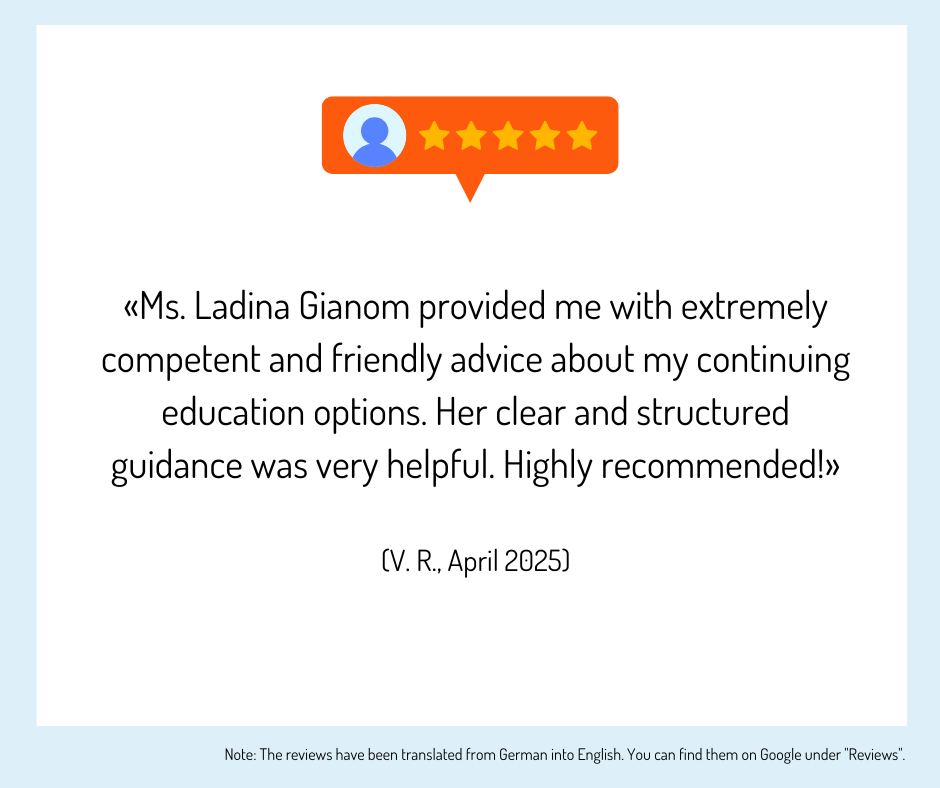
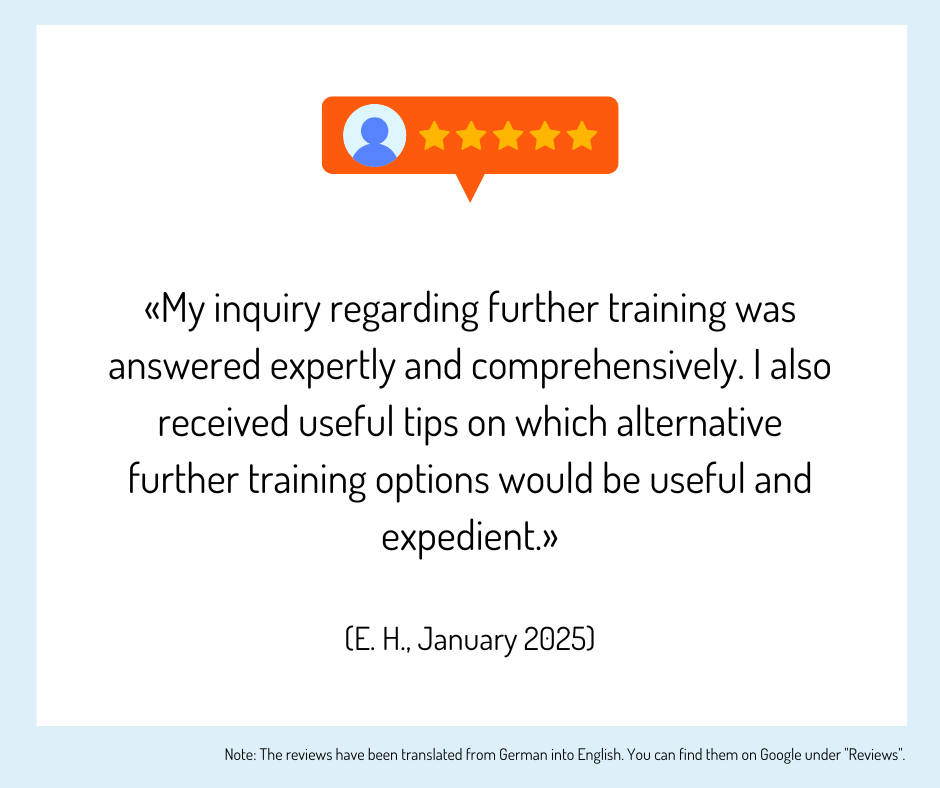
Experiences, evaluations and opinions on training/continuing education, further training
Haven't found the right training or further education yet? Benefit from educational advice now!
Further training is not only important in order to maintain or increase professional attractiveness, investing in training or further training is still the most efficient way to increase the chances of a pay rise.
The Swiss education system offers a wide range of individual training and further education opportunities - depending on your personal level of education, professional experience and educational goals.
Choosing the right educational offer is not easy for many prospective students.
Which training and further education is the right one for my path?
Our education advisory team will guide you through the "education jungle", providing specific input and relevant background information to help you choose the right offer.
Your advantages:
You will receive
- Suggestions for suitable courses, seminars or training programs based on the information you provide in the questionnaire
- An overview of the different levels and types of education
- Information about the Swiss education system
We offer our educational counseling in the following languages on request: French, Italian, English
Register now and concretize your training plans.



Attraktive Services für Swiss Post Mitarbeitende
Kostenlose Services
» Bildungsberatung (Wert: CHF 150.–)
Bildungs- und Businessratgeber (Wert: CHF 175.–)
» Rabatte
Attraktive Rabattierungen seitens der Bildungsanbieter.
Massgeschneiderte Bildungsangebote
Ohne grossen Zeitaufwand den besten Trainer, Coach oder Schulungsanbieter finden
Bildungsangebot Schweiz
Aus über 700 Bildungsanbietern das richtige Bildungsangebot finden

